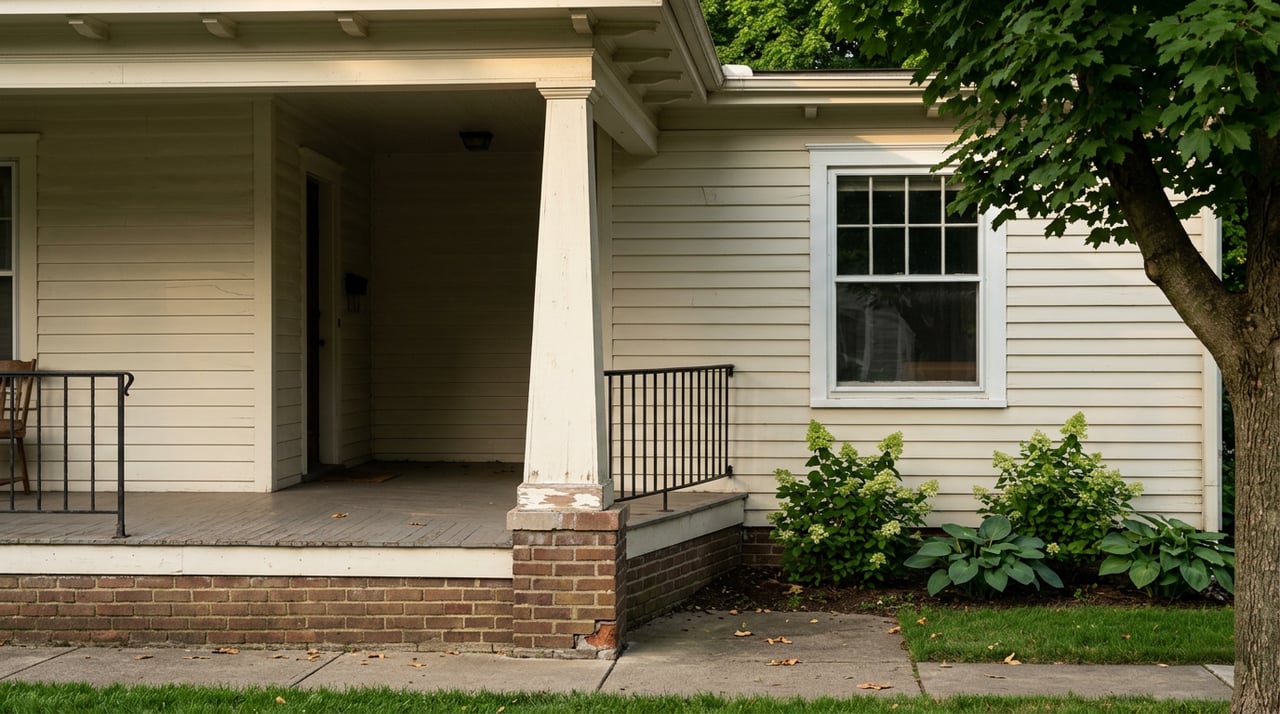
A buyer touring a 1920s bungalow on the near east side expects the inspector to find something. A sloped floor, an aging furnace, maybe a stretch of knob-and-tube in the attic they'd already guessed was there. What actually reroutes a sale on these blocks rarely comes from the inspector's clipboard. It comes from paperwork nobody reads closely until it's already a problem: an insurance underwriter who won't quote the home, a radon number that shows up on a form the seller filled out from memory, or a water line question tied to a program Madison finished more than a decade ago.
If you're preparing to list a pre-1950s home in Vilas, Tenney-Lapham, Marquette, Schenk-Atwood, Greenbush, Dudgeon-Monroe, Nakoma, or Regent/University Heights, three specific things are worth understanding before a buyer's team finds them for you.
The Wiring Problem the Inspector Doesn't Flag First
Knob-and-tube wiring was standard practice in home construction from the late 1800s through the 1940s, which puts a meaningful share of Madison's older bungalow stock squarely in its window, including homes inside the city's recognized historic districts. A home inspector will note it if they find it. But the party that actually stops a transaction cold is usually the insurance company. Most prominent national insurers operating in Wisconsin will flatly decline to write a homeowners policy on a property with active knob-and-tube wiring or an obsolete fuse box.
That timing matters more than it sounds. A buyer's lender typically requires proof of insurability before closing, which means the wiring question can surface during underwriting, sometimes before an inspection contingency period has even run its course. Wisconsin's Real Estate Condition Report, the standard disclosure form required under state law, also asks sellers directly about the condition of wiring. A seller who hasn't had an electrician look at the panel before listing is often answering that question with a guess, not an answer.
Radon Doesn't Know How New Your Kitchen Is
Here's the part that surprises even sellers who've done everything right. Radon comes up through the ground into a home's lowest level, which means it has nothing to do with the age of your electrical panel, your roof, or your kitchen renovation. A fully remodeled colonial in Nakoma and an untouched 1930s bungalow in Marquette carry the same baseline exposure to it, because the risk lives in the foundation and the soil underneath, not in anything a contractor replaced.
Public Health Madison and Dane County reports that roughly half of the homes tested locally over the past five years have come back with elevated radon levels, a figure that has nothing to do with a home's price point or renovation history. Testing is inexpensive: kits typically run under $25 at hardware stores, and Public Health Madison and Dane County sells them directly for $10. If a test does come back elevated, a properly installed reduction system can cut radon levels by up to 99 percent, and a typical mitigation system in the Madison area runs between $1,300 and $2,300. Wisconsin's disclosure form asks about radon directly. A seller who tests before listing answers that question with a number. A seller who doesn't answers it with a guess, and the buyer's own test, run during their inspection period, becomes the number that drives the negotiation instead.
The City Already Fixed the Water Lines. Except When It Didn't.
This is the one that catches longtime Madison sellers off guard, because it runs against something they believe is settled history. Madison was the first major U.S. city to launch a full lead service line replacement program, and by 2012 the utility had replaced every known lead line in its system, more than 8,000 of them, with copper. The Federal Reserve Bank of Chicago later described it as an 11-year effort that cost the city $15.5 million, funded in part by renting water tower space to cell carriers.
That history is real, and it's also incomplete as a guarantee for any individual address. Madison Water Utility's own site acknowledges that lead services are still occasionally discovered, usually when a property changes hands. The public side of the line, from the main to the curb stop, was the utility's responsibility and is well documented. The private side, from the curb stop to the house, was and still is the homeowner's, and older properties that never had that segment formally verified can surface a lead lateral at exactly the moment a title search or a new owner's plumbing work brings attention to it.
There's a wrinkle here worth flagging plainly: the city's own pages don't agree on the current rebate. One page cites a rebate of up to $3,000, another cites a rebate covering half the cost of replacement up to $1,500. Rather than repeat either number as gospel, the practical move is to call the utility directly before listing and get the current figure in writing.
It's also worth separating this from a completely different lead conversation that applies to the same houses. Any home built before 1978 falls under a federal disclosure requirement that has nothing to do with pipes: sellers must provide an EPA-approved pamphlet, disclose known lead-based paint hazards, and give buyers a defined window to inspect before they're obligated under the contract, using a Wisconsin-specific attachment known as Addendum S. A seller who assumes the city's pipe program covers this obligation is conflating two unrelated systems, one about plumbing infrastructure, one about painted surfaces, that happen to share a word.
| Issue | Who flags it first | Typical cost locally | When it surfaces |
|---|---|---|---|
| Knob-and-tube wiring | Insurance underwriter, not the home inspector | Case-by-case, driven by scope of rewiring | Often before an offer, when a buyer's insurer won't quote the policy |
| Radon | State disclosure form, or the buyer's own test | $10 to $25 to test; $1,300 to $2,300 to mitigate | Anytime, unrelated to renovation history |
| Lead service line | Madison Water Utility records, not the inspector | Rebate currently listed as either $1,500 or $3,000, depending on the page | Usually when the property changes hands |
| Lead-based paint | Federal disclosure law, homes built before 1978 | Testing and abatement costs vary by scope | Must be addressed within the offer's first 10 days |
The Ten-Day Window Most Sellers Don't Use to Their Advantage
Wisconsin law puts a clock on all of this. The Real Estate Condition Report is required to reach the buyer within a defined window tied to the accepted offer, and federal lead paint disclosure operates on its own 10-day inspection opportunity before a buyer is contractually obligated. Both timelines exist to protect buyers from being locked into a deal before they know what they're buying.
That same clock can work for a seller too, but only if they move ahead of it. Nolo's own guidance to sellers is direct: providing the condition report before an offer even arrives means the buyer enters the deal already informed, and can't later use the report itself as a reason to walk or renegotiate. Sellers on these blocks who wait for a buyer's inspector, insurer, or attorney to raise the wiring, the radon, or the water line are handing control of the number to the other side of the table. Sellers who test, verify, and disclose ahead of that ten-day window keep the number theirs to set.
A Few Straight Answers
Does an old Madison home automatically have knob-and-tube wiring? Not necessarily. The wiring era runs from the late 1800s through the 1940s, but plenty of owners have rewired in the decades since for reasons unrelated to a sale. The only way to know for certain is to have an electrician look at the panel and any unfinished attic or basement runs before a buyer's insurer asks the question for you.
If my radon test comes back high, am I required to fix it before listing? Wisconsin's disclosure form asks whether you're aware of an issue, not whether you've resolved one. Testing ahead of listing simply means you're answering that question with a real number instead of a guess, and a mitigation system that reduces levels by up to 99 percent is a straightforward fix if you choose to make it before a buyer's own test forces the timeline.
Madison already replaced the lead lines. Why would mine still be an issue? The city's program covered the public side of the line, from the main to the curb stop, and that work is documented and complete. The private side, running from the curb stop into the house, was always the homeowner's responsibility, and on some older properties it was never formally verified. A quick call to Madison Water Utility before listing settles the question and gets you the current rebate figure in writing.
Selling a home built before 1950 in Madison isn't harder than selling anywhere else. It just runs on a different set of triggers, and most of them belong to an underwriter, a lab result, or a utility record rather than a home inspector's flashlight. The See Team has walked enough of these near east and near west side sales to know which of the three usually shows up first on a given block, and can help you get ahead of all three before a buyer's team finds them on their own timeline instead of yours.